Volume: 3 Issue: 3
Strange Lodgers: Sixteen Curious Cases of Foreign Bodies in the Aerodigestive Tracts
Year: 2026, Page: 134-138, Doi: https://doi.org/10.71325/ajjms.v3i3.26.45
Received: Sept. 1, 2026 Accepted: Sept. 12, 2026 Published: Oct. 10, 2026
Abstract
Foreign body ingestion and aspiration remain significant clinical challenges in otorhinolaryngology practice, with varied presentations requiring diverse management approaches. Objective of the study is to analyze the clinical characteristics, management strategies, and outcomes of unusual foreign body cases in the aerodigestive tract. We present a retrospective case series of 16 patients with foreign bodies in the aerodigestive tract treated at our institution. Cases were selected based on unusual presentations, extraluminal migration, or challenging extraction techniques. The series included 11 males (68.8%) and 5 females (31.2%) with ages ranging from 3 to 92 years. Organic foreign bodies (bones) were most common (56.2%), followed by prosthetic devices (18.8%). Direct laryngoscopy was the primary intervention (56.2%), while extraluminal approach was required in 18.8% of cases. All cases achieved successful foreign body removal with no mortality. Unusual foreign body cases require individualized management approaches, with extraluminal surgical techniques playing a crucial role in complex presentations. Early recognition and appropriate intervention are essential for optimal outcomes.
Keywords: Foreign body, Aerodigestive tract, Extraluminal approach, Direct laryngoscopy
INTRODUCTION
Foreign body ingestion and aspiration represent common emergencies in otorhinolaryngology practice, accounting for significant morbidity and occasional mortality worldwide. While most cases involve straightforward endoscopic removal, certain presentations pose unique challenges due to the nature of the foreign body, anatomical location, duration of impaction, or patient-specific factors[1].
The aerodigestive tract, encompassing structures from the nasal cavity to the lower oesophagus, provides multiple sites for foreign body lodgement. Traditional management approaches include flexible and rigid endoscopy under general anaesthesia, with surgical intervention reserved for complicated cases. However, unusual presentations may require innovative approaches, including extraluminal surgical techniques for migrated foreign bodies[2].
Extraluminal migration of foreign bodies represents a particularly challenging scenario, occurring when sharp objects penetrate through the mucosal wall into surrounding tissues. These cases often require external surgical approaches through lateral neck exploration, as endoscopic retrieval becomes impossible and potentially dangerous[3].
The demographic patterns of foreign body ingestion show bimodal distribution, with peaks in paediatric populations (particularly ages 6 months to 6 years) and elderly patients, especially those with psychiatric conditions or dementia. The types of foreign bodies vary significantly between age groups, with coins and small objects predominating in children, while food bolus and bone fragments are more common in adults[4].
This case series presents 16 unusual cases of aerodigestive tract foreign bodies from August 2024 to August 2025, highlighting the diverse presentations and management strategies required for optimal patient outcomes. The cases demonstrate the importance of individualized treatment approaches and the critical role of surgical expertise in complex presentations.
CASE SERIES
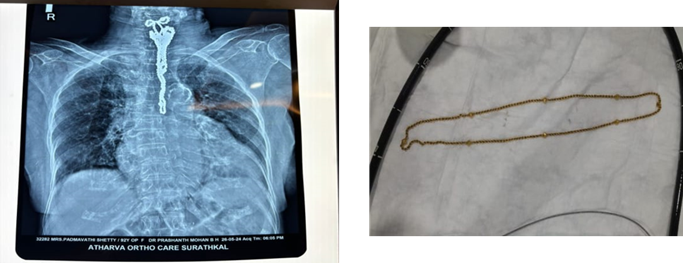
Case 1: Massive Chain Ingestion with Psychiatric Background
A 92-year-old female with a history of psychiatric illness presented with dysphagia following consumption of a 20-25 cm metallic chain. Initial X-ray showed the chain extending from C5-T5 vertebrae, but pre-procedure imaging revealed migration to the stomach. Upper gastrointestinal endoscopy successfully removed the entire chain. The case required concurrent psychiatric evaluation and management of the underlying condition.
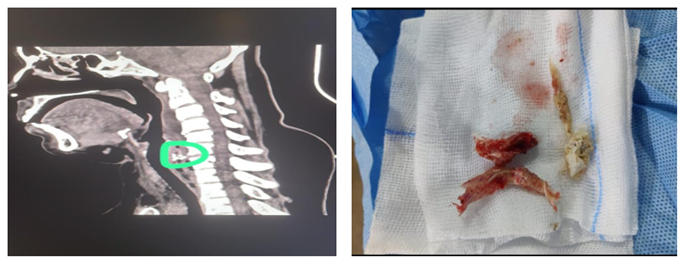
Case 2: Impacted two Chicken Bone with meat
A 38-year-old male developed severe dysphagia after chicken bone consumption. Lateral neck X-ray showed a suspicious foreign body, with CT neck confirming hyperdensity from C5-T1 vertebral levels. Two chicken bone fragments along with meat were successfully removed using combined direct laryngoscopy and esophagoscopy under general anaesthesia.
Case 3: Chicken bone with multiple meat pieces
A 22-year-old male developed a foreign body sensation in the throat following consumption of a chicken bone. CT of the neck was done and was suggestive of a foreign body at the C6 vertebral level. The chicken bone was removed by direct laryngoscopy under general anesthesia.
Case 4: Hook of Denture
A 66-year-old female complained of a throat-pricking sensation after consuming hard food. X-ray showed a linear opacity in the post-cricoid region. Direct laryngoscopy revealed a hook of denture fragments, which were successfully removed under general anaesthesia. Post-operative dental evaluation and care were provided.
Case 5-7: Various Metallic Objects
Cases 5-7 included patients aged 3-22 years with metallic foreign bodies (ring, coins) at various cervical levels. All were successfully managed with direct laryngoscopy under general anaesthesia, demonstrating the effectiveness of standard endoscopic approaches for most presentations.
Cases 8-10: Standard Bone
Three patients (ages 30-60) presented with typical bone fragments: one fish bone and one chicken bone in the cricopharynx at the C5-C6 vertebral level, which is the most common site for foreign body lodgement. The third patient had a chicken bone in the right pyriform fossa, as suggested by CT of the neck, and was removed by direct laryngoscopy under general anaesthesia.
Cases 11-12: Slip and Swallow Denture
A 48-year-old male accidentally swallowed his upper full denture while eating, developing immediate dysphagia. CT of the neck localized the foreign body in the oesophagus at the T2 level. Rigid oesophagoscopy under general anaesthesia achieved successful denture removal without complications.
A 65-year-old female presented with dysphagia after swallowing an implanted denture. X-ray of the erect abdomen showed the denture hook between the T10-T11 vertebral levels. Esophagoscopy was done, and the denture was removed under general anaesthesia.
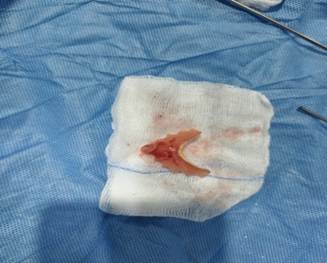
Case 13: Paediatric Fish Bone in Valleculae
A 4-year-old male presented with right-sided throat sensation after fish bone consumption. CT of the neck demonstrated hyperlinear density in the right valleculae. Direct laryngoscopy under general anaesthesia successfully removed the fish bone from the right valleculae.
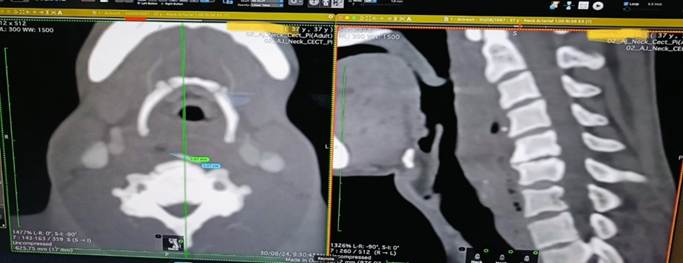
Cases 14-16: Extraluminal Migration Cases
Four patients (ages 33-68) presented with extraluminal foreign body migration, representing the most challenging cases in this series. These patients required external cervical exploration through extraluminal approaches due to penetration of foreign bodies through the pharyngeal or oesophageal wall into surrounding tissues. All cases achieved successful foreign body removal through lateral neck exploration under general anaesthesia.
RESULTS
This case series of 16 unusual foreign body presentations in the aerodigestive tract demonstrates the complexity and diversity of clinical scenarios encountered in otorhinolaryngology practice. Key findings include the predominance of organic foreign bodies, effectiveness of direct laryngoscopy for most cases, and the critical role of extraluminal surgical approaches for complex presentations.
The 100% success rate in foreign body removal with no mortality supports the safety and efficacy of individualized management approaches. Extraluminal migration, occurring in 18.8% of cases, represents a significant challenge requiring advanced surgical techniques and careful preoperative planning.
Early recognition, appropriate imaging evaluation, and selection of optimal removal techniques are essential for successful outcomes. The bimodal age distribution emphasizes the need for age-specific approaches, with particular attention to paediatric safety and elderly complexity factors.
Future research should focus on developing standardized protocols for extraluminal migration management and investigating preventive strategies for high-risk populations. The increasing use of CT imaging for diagnostic evaluation and surgical planning represents an important advancement in foreign body management.
This series contributes to the literature by highlighting unusual presentations and demonstrating the successful application of both endoscopic and surgical techniques in challenging foreign body cases. The experience supports maintaining expertise in both conventional endoscopic methods and advanced extraluminal surgical approaches for optimal patient care.
DISCUSSION
This case series demonstrates the diverse spectrum of foreign body presentations in the aerodigestive tract, ranging from straightforward endoscopic removals to complex extraluminal migrations requiring surgical exploration. The demographic distribution aligns with established literature, showing predominance in paediatric and elderly populations, with a male preponderance (68.8%).
The high prevalence of organic foreign bodies (56.2%), particularly bone fragments, reflects dietary habits and emphasizes the importance of careful mastication, especially in elderly patients with dental problems. The significant proportion of prosthetic devices (18.8%) highlights the growing concern with increasing denture use in aging populations[5].
Management Strategies and Technical Considerations
Direct laryngoscopy emerged as the primary intervention (56.2%), confirming its effectiveness for most aerodigestive foreign bodies. The procedure allows direct visualization and precise instrument control, essential for safe foreign body extraction. Success rates for endoscopic removal typically exceed 94%, as demonstrated in multiple series.
The notable finding of extraluminal migration in 18.8% of cases underscores the importance of advanced surgical techniques in foreign body management. Extraluminal approach becomes necessary when sharp foreign bodies penetrate the mucosal wall, making endoscopic retrieval dangerous and potentially impossible. These cases require lateral neck exploration with careful dissection to locate and remove embedded foreign bodies while avoiding vital structures[6].
Age-Related Considerations
Paediatric cases (25% of series) presented unique challenges, including patient cooperation and anatomical considerations. All paediatric procedures were performed under general anaesthesia, which is standard practice for this population to ensure safety and completeness of removal. The predominance of metallic objects (coins, ring) in paediatric cases reflects typical childhood ingestion patterns.
Elderly patients (25% of series) showed increased complexity, often involving dental prostheses and underlying medical conditions. The 92-year-old patient with psychiatric illness represents an extreme case requiring multidisciplinary management, including psychiatric evaluation alongside foreign body removal[7].
Imaging and Diagnostic Approaches
The series demonstrates the evolution of diagnostic imaging, with CT neck playing an increasingly important role in localizing radiolucent foreign bodies and planning surgical approaches. Plain radiography remains useful for radiopaque objects but has limitations for organic materials and dental prostheses.
CT imaging proved particularly valuable in extraluminal migration cases, allowing precise localization and surgical planning. The ability to visualize foreign body relationship to vital structures is crucial for safe extraluminal approaches[8].
Complications and Outcomes
The series achieved a 100% success rate in foreign body removal with no mortality, consistent with contemporary literature showing excellent outcomes when appropriate techniques are employed. The absence of major complications reflects careful case selection, appropriate technique choice, and experienced surgical management.
Surgical Innovation and Extraluminal Techniques
The successful management of extraluminal migration cases highlights the importance of surgical expertise beyond standard endoscopic techniques. Lateral neck exploration requires thorough understanding of cervical anatomy and careful dissection techniques to avoid injury to vital structures, including the recurrent laryngeal nerve and major vessels[3].
Clinical Implications and Future Directions
This series emphasizes the need for individualized management approaches based on foreign body characteristics, location, and patient factors. The high success rate with varied techniques supports a flexible algorithmic approach, starting with endoscopic methods and progressing to surgical exploration when indicated.
Prevention strategies, including patient education about careful mastication and proper denture fitting, remain crucial for reducing foreign body incidence. The psychiatric component in Case 1 highlights the importance of underlying condition management in preventing recurrent episodes[1].
DECLARATIONS
Funding: This work did not receive any contribution, funding, or scholarship.
Conflict of Interest: The authors declare that there is no conflict of interest regarding the publication of this paper.
Ethical Approval: The authors declare that they have written consent for the use of photographs of patients in this article.
References
1. Thammaiah P, Manideep C, Madhusudana Rao C, Sricharan R. Unusual Case of a Foreign Body in Tracheo-Esophageal Party wall. Indian Journal of Otolaryngology and Head & Neck Surgery. 2023; 75 (3). Available from: https://doi.org/10.1007/s12070-023-03698-1
2. Devaraja K, Nayak DR, Bhandarkar AM, Sharma PV. Usual suspects: the foreign bodies of the aerodigestive tract. BMJ Case Reports. 2018; 2018 Available from: https://doi.org/10.1136/bcr-2018-224979
3. Hariga I, Khamassi K, Zribi S, Amor MB, Gamra OB, Mbarek C, et al. Management of Foreign Bodies in the Aerodigestive Tract. Indian Journal of Otolaryngology and Head & Neck Surgery. 2014; 66 (S1). Available from: https://doi.org/10.1007/s12070-011-0436-y
4. Bekkerman M, Sachdev AH, Andrade J, Twersky Y, Iqbal S. Endoscopic Management of Foreign Bodies in the Gastrointestinal Tract: A Review of the Literature. Gastroenterology Research and Practice. 2016; 2016 Available from: https://doi.org/10.1155/2016/8520767
5. Ullal A, Mishra S, Mundra RK. Unusual foreign bodies of the airway: a case series regarding their management. International Journal of Otorhinolaryngology and Head and Neck Surgery. 2018; 4 (4). Available from: https://doi.org/10.18203/issn.2454-5929.ijohns20182720
6. Lotterman S, Sutton AE, Hohman MH. Ear Foreign Body Removal. Treasure Island (FL): StatPearls Publishing. 2025; Available from: https://www.ncbi.nlm.nih.gov/books/NBK459136/
7. Bajaj N, Kanoriya D. Incidence and management of foreign bodies in aerodigestive tract in a tertiary level. International Journal of Medical Research and Review. 2019; 7 (4). Available from: https://ijmrr.medresearch.in/index.php/ijmrr/article/view/1072
8. Kumari S, Bala N, Haq AU, Kalsotra P. Clinical Profile and Management of Aerodigestive Foreign Bodies: A Prospective Observational Study. JK Science. 2022; 24 (1). Available from: https://journal.jkscience.org/index.php/JK-Science/article/download/105/96/99
Copyright
© 2026 Published by Laxmi Memorial Education Trust. This is an open-access article under CC BY 4.0 license. (https://creativecommons.org/licenses/by/4.0/)
Cite this article
Deepalakshmi Tanthry, Gururaj Tanthry, Vishwas K Pai, C S Chethana, R Apoorva. Strange Lodgers: Sixteen Curious Cases of Foreign Bodies in the Aerodigestive Tracts. AJ J Med Sci 2026;3(3):134-138